

Rambo's hometown
The mean streets of Bowie, Arizona

A line of dialogue spoken in the first few minutes of “Rambo: First Blood, Part II” establishes that the disaffected Vietnam veteran John Rambo was born in Bowie, Arizona.
The only homage you’ll find to this famous fictional son in his hometown is this mural painted on the wall of the Chevron station, owned by a Sikh family who also sell Indian food.
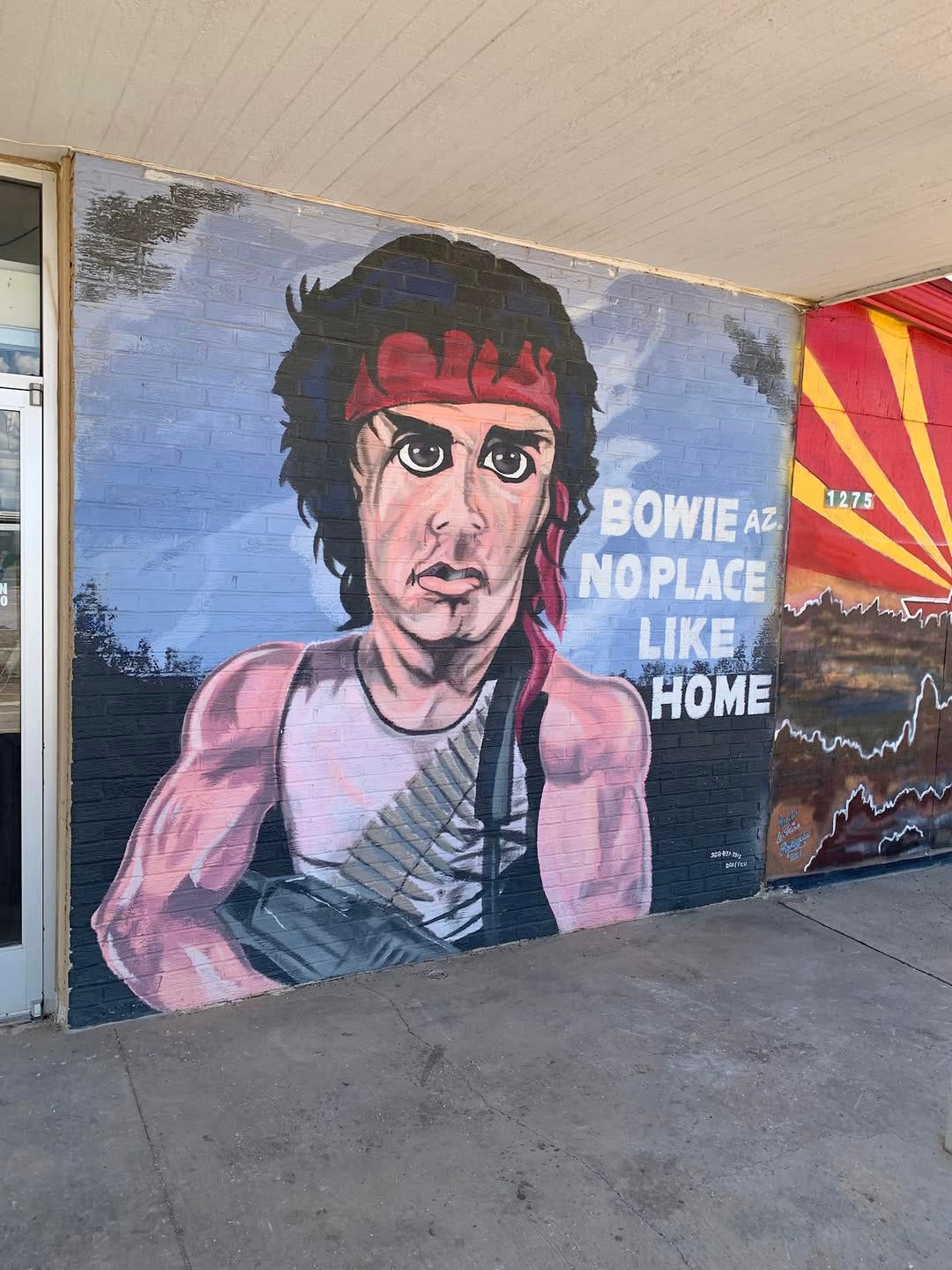
In the Rambo novels by David Morrell, the protagonist briefly describes Bowie as a “small place” where he had a miserable childhood fighting against his alcoholic father before shooting him with a crossbow and signing up for the Army Special Forces at age 17.
I’ve included a link to the aforementioned film dialogue in the comments. You’ll hear the Bowie reference at around the 6:30 mark, spoken by a military official named Murdock summing up Rambo’s personnel file.
(Two asides: only cops and soldiers are allowed to have the surname “Murdock” in a film. And the character is played by Charles Napier, who you might also recognize as the frontman of the hapless Good Old Boys in “The Blues Brothers,” and one of the many victims of Hannibal Lechter in “Silence of the Lambs”).
Before this moment, you’ll see a fake-as-hell hard labor camp where the convicts are perfectly arranged on a pile of rocks giving baby taps to quarry spikes. Seriously, it looks like the set of a Broadway musical. And Rambo sports the most luxurious blow-dried locks down to his shoulders that was ever seen in a maximum security prison.
The real life Bowie (pop. 647) was founded in 1880 as a supply depot off the Southern Pacific Railroad for nearby Fort Bowie. While the character Rambo famously wields a Bowie knife (an implement named for Alamo hero James Bowie) the fort and the town actually took their names from George Washington Bowie, the commander of the 5th California Infantry Regiment.
Today the place is home to two pecan-growing operations, a cluster of desert-worn houses and two gas stations serving Interstate 10 not far from the border of New Mexico.
The fort in the nearby hills was decommissioned in 1892, six years after the capture of Geronimo brought an end to the Apache Wars
.